
The operationalization gap: a self-check for retail leaders
Vivek Abraham, Enterprise Commerce Lead, G10X
10 questions to ask before your next AI, supply chain, or loyalty investment.
G10X's Retail trends report 2026/2027 traces one pattern across 10 parts of the retail business: budgets for AI, personalization, supply chain, loyalty, and more are growing, but the operational proof that those investments actually work is not keeping pace. 90% of retailers plan to increase AI budgets in 2026, yet McKinsey found that only 7% have fully scaled AI. The report calls the space between those two numbers the operationalization gap.
That distinction, drawn out across all 10 trends in the report, is what separates retailers who capture value from these shifts from those who don't. This piece turns the framework into something practical: 10 questions, one for each trend, that a retail leader can ask about their own organization right now. None of them require a new deployment. All of them require honest evidence.
Work through them in order, or jump to the ones closest to what you're already working on.
Question 1
Can you name which AI use cases have moved from pilot to production, and what operational metric proves it?
Budget growth alone doesn't answer that, see the gap above. A useful benchmark: after adopting AI-assisted scheduling, Starbucks UK cut manual scheduling time by 87.5%. This is an example of a specific, measurable operational outcome, not a rollout announcement. If your organization can't point to a comparable before-and-after metric for at least one AI use case, the budget is ahead of the capability.
Question 2
If an AI agent attempted fraud against your business today, would you detect it before it cost you money, or only after?
69% of organizations have already experienced AI-enabled fraud, but only 3% feel fully prepared for it, and 87% expect the problem to grow. Bot-initiated transactions are already rising fast, up 25% globally and 40% in the US over a recent six-month window. Agentic AI raises the stakes because it acts at machine speed. A fraud-detection process built for human-paced review is not readiness, it is exposure.
Question 3
Is your value proposition built for a customer who compares price on every purchase, or only during sale periods?
40% of Americans are now consistent value seekers, not occasional bargain hunters, and our report treats this as a permanent shift rather than a cyclical dip. Retailers built around that reality are already seeing it in same-store sales: TJX and Ross posted 4% and 5% gains respectively while pricing around everyday value, and the US secondhand market is projected to reach $78.8 billion by 2030. If your pricing and promotion strategy still assumes value-seeking is seasonal, it is measuring the wrong thing.

Question 4
Has anyone on your team tested the handoff between channels this quarter, start to finish, the way a customer actually experiences it?
46% of retailers cite omnichannel as their top growth opportunity, and omnichannel customers shop 1.7 times more than single-channel customers. Those numbers describe the upside. They say nothing about whether the handoff actually works. Readiness here is not a strategy document, it is evidence: a return started online and completed in-store, a browsing history that follows the customer to a different device, tested on a regular cadence rather than assumed to still be working since the last major release.
Question 5
What share of your customer journey is personalized today, measured, not planned?
Only 26% of retailers have deployed AI personalization at scale, despite 67% expecting to within the year, a gap between intention and delivery that should sound familiar by now. Independent research from Adobe and Incisiv found the same pattern industry-wide: on average, less than half of the shopper journey is personalized, and only 16% of retailers personalize 75% or more of it, the threshold the research uses to define a “leader.” If your personalization roadmap is measured in initiatives launched rather than journey coverage achieved, it is optimistic, not operational.
Question 6
How current is your supply chain and pricing data, and how fast can your organization act on what it shows?
95% of retailers anticipate higher costs from trade policy shifts, and 66% are actively restructuring their supply chains in response; AI adoption for supply chain visibility is expected to climb from 30% to 41% within the next year. G10X's work with Stonegate Group shows what closing this gap looks like in practice: moving from biannual to quarterly pricing surveys through an OCR-based automation platform cut survey turnaround by 90%, while eliminating manual data entry cut cost by 50%. The turnaround gain is what matters here: that is the difference between having data and having data you can act on before it goes stale.
Question 7
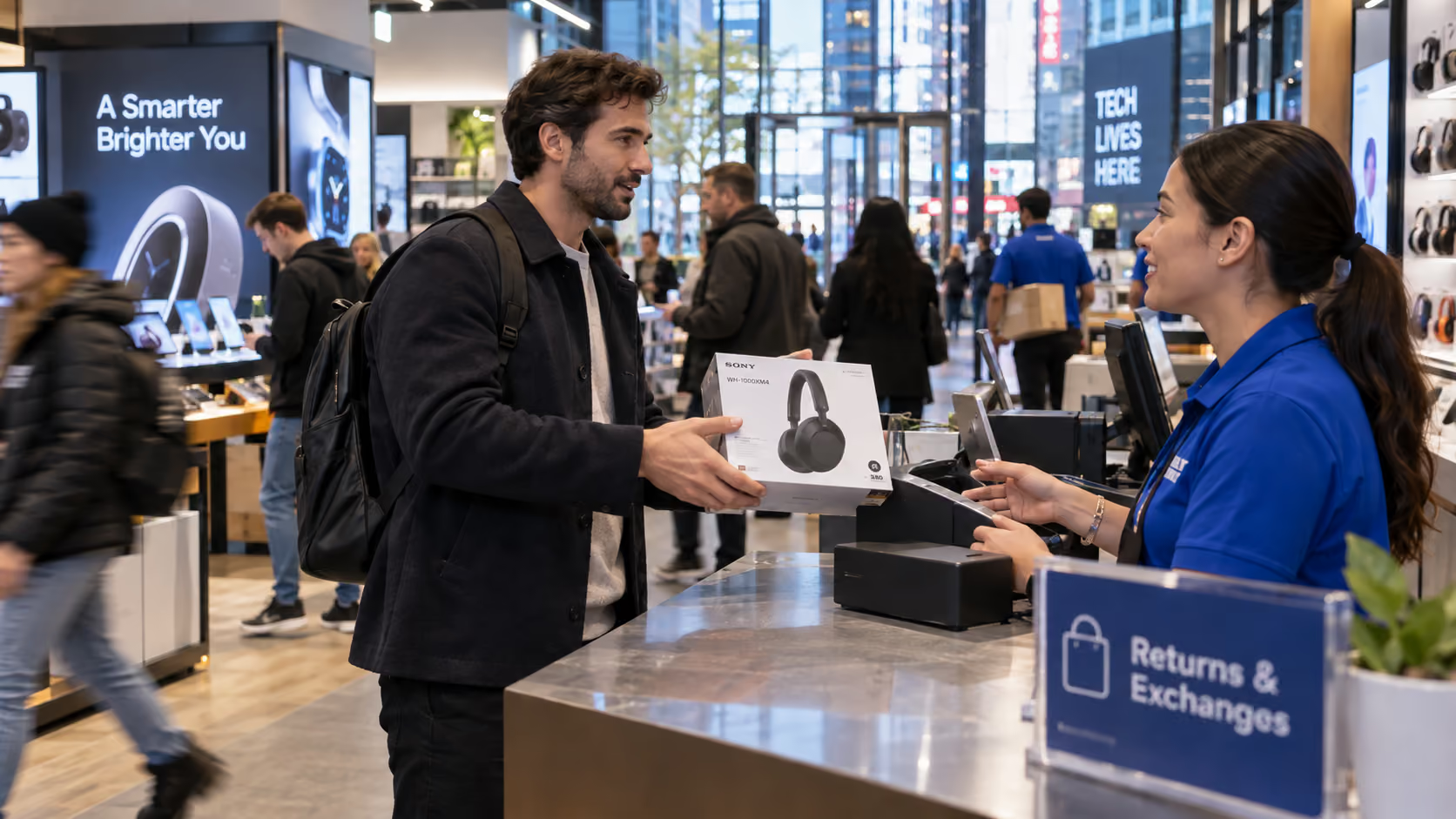
Do you know your organization's true return rate and cost, and was your returns process designed, or did it just accumulate?
US retail returns totaled roughly $849.9 billion in 2025, and the online return rate now sits at 19.3%. Returns policy changes made without operational readiness carry real reputational risk: when PrettyLittleThing began charging for returns in 2024, the backlash was immediate and public. A returns process is operationally ready when the team can explain the cost, the customer experience, and the policy rationale as one connected story, not three separate ones.
Question 8
Is your retail media capability generating measurable revenue today, or is it still a roadmap item?
88% of retailers say retail media is crucial to revenue and profitability going forward. That level of confidence is only useful if it is backed by a working measurement framework, an actual media offering, and a clear owner. The report's broader pattern applies here too: ambition consistently outpaces deployed, provable capability.
Question 9
Does your loyalty program recognize the same customer across every channel, or does the data fragment the moment they switch devices?
The global loyalty market reached roughly $3 trillion in 2024, and 36% of retailers name loyalty as a top growth opportunity for 2026. Our report traces the underlying obstacle to customer data management: identity fragmentation, not rewards mechanics, is usually what breaks a loyalty program's ability to actually personalize what it offers. If your program can't resolve a customer's history across channels into one record, no amount of rewards redesign will fix what's underneath it.
Question 10
Is your physical footprint designed to drive discovery, or only to fulfill orders placed somewhere else?
Roughly 80% of global retail revenue still runs through physical stores, and retailers are reinvesting accordingly. As an example, Walmart is remodeling more than 650 locations. The operational question is whether that investment is aimed at discovery, the reason a customer walks in without already knowing what they want, or only at fulfillment efficiency. Both matter, but only one of them is where most retailers are underinvesting.
10 trends, one pattern. Across every one of these areas, the retailers pulling ahead are not the ones who deployed first. They are the ones who can prove, on demand, that what they built still works under real conditions.
If more than two or three of these questions produced an honest “I don't know,” that is not a diagnosis of failure. It is a starting point. Read the full Retail trends report 2026/2027 for the data behind each trend.
related insights




Get in touch
Let’s build what’s next, together. From seamless integration to smarter systems, we’ll help you move faster and stay ready for what comes next.